
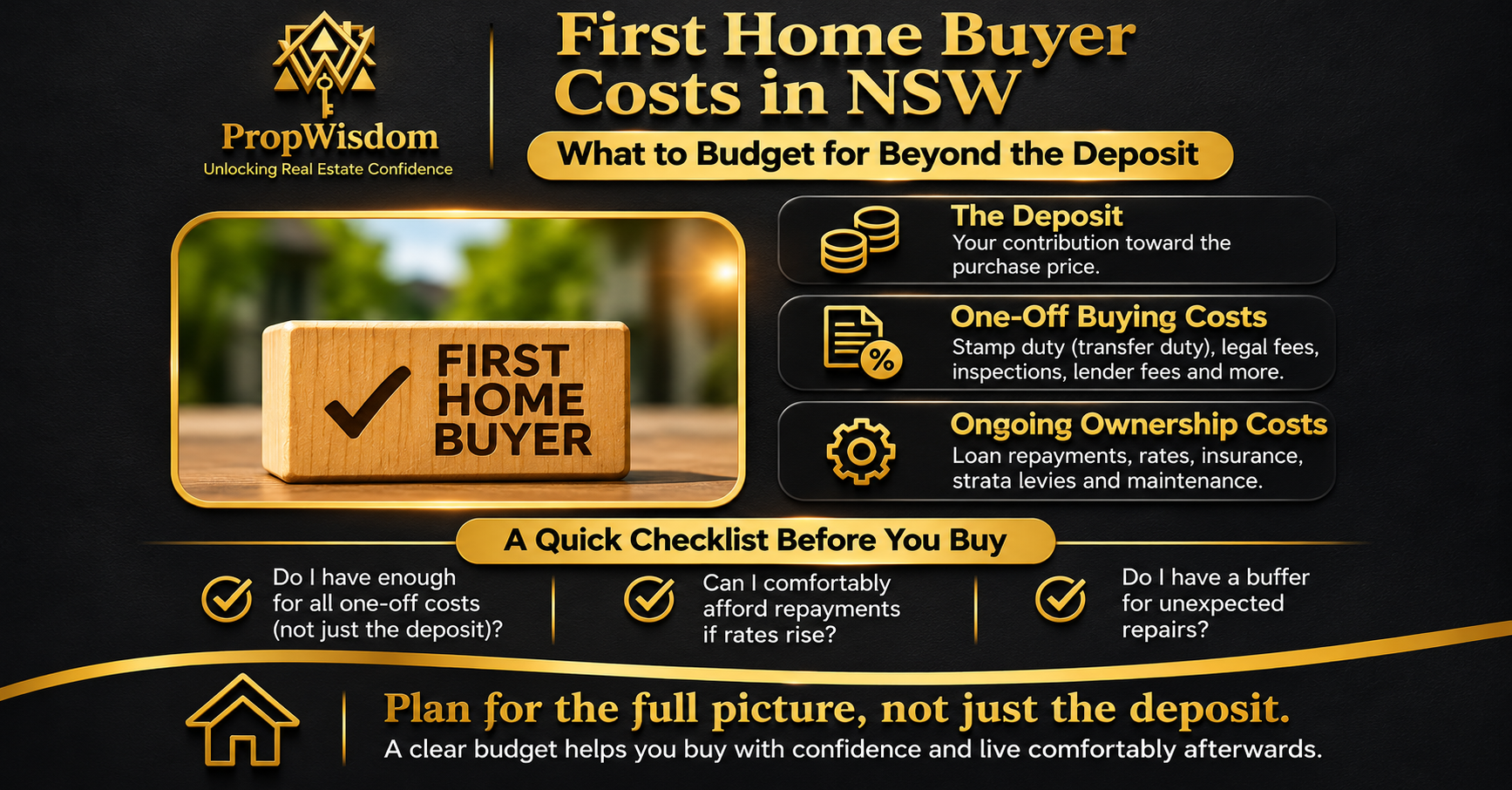
First Home Buyer Costs in NSW: What to Budget for Beyond the Deposit
"I have saved my deposit. I'm ready to buy."
We hear this a lot, and saving a deposit is a real
achievement. But the deposit is only one line in the budget. Many first homebuyers in NSW are surprised by how many other costs sit between "I've
found the one" and "I've got the keys". Even more are surprised
by the costs that keep coming after settlement.
This guide covers the one-off costs of buying, the ongoing
costs of owning, and a simple three-question check to run before you make an
offer. The buyers who feel calm after settlement are usually the ones who
planned for the whole picture, not just the deposit.
How Much Do You Really Need to Buy a First Home in NSW?
The price on the listing is not the full cost of buying. A
useful way to think about it is in three layers:
- The
deposit, which is what you put towards the purchase price.
- The
one-off costs of buying, such as duty, legal fees, inspections and
lender fees.
- The
ongoing costs of owning, such as repayments, rates, insurance and
maintenance.
Most buyers plan well for layer one, partly for layer two,
and barely at all for layer three. The sections below cover each.
One-Off Costs of Buying a Home
Stamp Duty (Transfer Duty) in NSW
In NSW, stamp duty is officially called transfer duty.
It is usually one of the largest costs outside the deposit, but first home
buyers may get significant relief.
Under the NSW First Home Buyers Assistance Scheme, eligible first home buyers purchasing an existing property for $800,000 or less pay no transfer duty at all. The same page explains that a full or partial exemption is available on new or existing homes valued up to $1 million, or on vacant land up to $450,000. For vacant land, the full exemption applies up to $350,000, with concessional rates from $350,001 to $450,000. First Home Buyers Assistance Scheme +2
A few points matter here:
- Eligibility
rules apply. The scheme is for genuine first home buyers who meet
residency and other requirements, and the transfer must be for the whole
property.
- Thresholds
change. Government settings are reviewed from time to time, so confirm
the current figures before you set your budget.
- Just
over the threshold costs real money. If a property sits above the
exemption threshold, you move into the concessional rate or full duty.
This is one reason it pays to check your target price range against the
thresholds early.
Check the current details on the NSW Government's First Home Buyers Assistance Scheme page, or confirm with Revenue NSW or your conveyancer.
First Home Owner Grant (New Homes)
Legal and Conveyancing Costs
You will need a conveyancer or solicitor to review
the contract, handle the legal side of the purchase and manage settlement. Fees
vary by provider and by how complex the transaction is, so get a clear quote
upfront, including disbursements such as searches and registration fees.
A good conveyancer reads the contract before you commit. Do
this before you sign or exchange, not after.
Building and Pest Inspection
A pre-purchase building and pest inspection is one of
the best-value costs in the whole process. It can reveal structural issues,
termite activity, moisture problems or defects that would otherwise be
expensive surprises after settlement. It can also give you information to
negotiate with, or a reason to walk away.
If an inspection finds problems, that is useful. The cost of
the inspection is small compared to the cost of finding out later.
Strata Report (Units and Townhouses)
If you are buying a unit or townhouse, ask for a strata
report. It covers the building's finances, levies, sinking fund (also
called the capital works fund), meeting minutes, special levies and any known
defects or disputes. A strata report can change a buying decision, so it is
worth reading carefully or having a professional review it.
Loan Application, Valuation and Lender Fees
Depending on your lender, you may face application fees,
valuation fees, settlement fees, and mortgage registration costs. Some lenders
waive some of these, and others charge them. Your broker can compare the total
cost, not just the interest rate.
Moving and Setting Up Costs
This category is the easiest to underestimate. Think about:
- Removalists
or van hire
- Connecting
electricity, gas, internet and other utilities
- Changing
locks
- Basic
furniture, window coverings and appliances
- Cleaning,
garden tools, smoke alarm checks and small repairs
Individually these seem small. Together they can add up
fast, and they all land right when your savings are at their lowest.
The Costs That Continue After Settlement
This is the part that surprises first home buyers the most. Settlement day is not the end of the spending. It is the start of a new, ongoing budget.
Council and Water Rates
Every property owner pays council rates and water charges,
and these arrive regularly throughout the year. The amounts vary by council
area, property type and usage, so check the likely cost for any property you
are seriously considering.
Home and Contents Insurance
Lenders generally require building insurance, and contents
insurance protects your belongings. Premiums vary based on location, building
age and construction, flood and bushfire risk, and the cover you choose. Get
quotes before you commit to a property, especially in areas with higher natural
hazard risk.
Strata Levies
If you buy into a strata building, you will pay regular
levies to cover building insurance, maintenance, cleaning, management and
contributions to the sinking fund. Special levies can also be raised for major
repairs. Always check the history of levies and any planned works before you
buy.
Maintenance and Repairs
Every home needs maintenance. Roofs, plumbing, hot water
systems, appliances, painting, gutters, pest control and fencing all need
attention eventually. Older homes tend to need work sooner, but even newer
homes need ongoing care.
A good habit is to build a repair buffer from day one
and keep topping it up. If nothing breaks for a year, you are ahead. If
something does, you are ready.
A Simple Way to Check Your Numbers
Before you make an offer, ask yourself three questions:
- If
I add up every one-off cost, do I still have savings left after
settlement? The goal is not to finish settlement with exactly zero.
- Can
I comfortably cover repayments if rates rise from today's level? Test
your budget at a higher rate than you are being offered now.
- Do
I have a buffer for a repair I did not plan for? A burst pipe or a
failed hot water system does not wait for payday.
If the answer to any of these is no, that is useful to know
before you make an offer, not after.
A Quick Budgeting Checklist
Use this as a starting point and fill in real quotes as you
go:
Before you buy
- Deposit
- Transfer
duty (after checking First Home Buyers Assistance Scheme eligibility)
- First
Home Owner Grant, if buying new and eligible
- LMI,
or confirmation that you qualify to avoid it
- Conveyancer
or solicitor fees
- Building
and pest inspection
- Strata
report, if relevant
- Lender,
valuation and registration fees
Moving in
- Removalists
- Utility
connections
- Locks
and security
- Essential furniture and appliances
Common First Home Buyer Budgeting Mistakes
Spending the buffer on the deposit. Putting every
dollar into the deposit can leave you with nothing for the costs that follow.
Budgeting to the maximum borrowing amount. A lender
saying you can borrow a certain amount does not mean you can comfortably repay
it.
Forgetting the thresholds. A few thousand dollars on
the purchase price can change how much duty you pay, so know the numbers before
you negotiate.
Skipping due diligence to save money. Skipping an
inspection or strata report to save a few hundred dollars can cost many times
that.
Ignoring ongoing costs. A cheaper property with high
strata levies or high insurance can cost more to own than a slightly pricier
one with lower running costs.
Frequently Asked Questions
Do first home buyers pay stamp duty in NSW?
Many do not, or they pay a reduced amount. Eligible first
home buyers may receive a full exemption or concession under the First Home
Buyers Assistance Scheme, depending on the property's value and type. Confirm
the current thresholds with Revenue NSW or your conveyancer.
How much do I need on top of my deposit to buy a first
home?
It depends on the purchase price, your loan, your
eligibility for concessions, and the type of property. The best approach is to
total every one-off cost, add moving and setup costs, and then keep a buffer. A
broker and conveyancer can help you get realistic numbers.
Can I buy a home with a 5% deposit and avoid LMI?
Eligible first home buyers may be able to, through the
Australian Government 5% Deposit Scheme. Property price caps and other
eligibility criteria apply, and you apply through a participating lender.
Compare the long-term cost of the larger loan against the upfront saving.
What ongoing costs should I budget for after buying?
Loan repayments, council and water rates, home and contents
insurance, strata levies (if applicable), and maintenance and repairs.
How big should my repair buffer be?
There is no single right number. It depends on the age and condition of the home and your comfort with risk. Older homes and houses with larger gardens, roofs or pools tend to need a larger buffer. Your inspection report is a good guide to what might need attention soon.
The Bottom Line
The deposit gets you to the starting line. A clear picture
of the full cost helps you buy with confidence and live comfortably afterwards.
Plan for the one-off costs, test your repayments at a higher rate, and keep a
buffer for the things you cannot predict.
Before you make your first offer, let's make sure the full
numbers are on the table.
Hardeep , PropWisdom
Hardeep: 0415 246 767
Pick a time to talk
This article is general information only and isn't
financial advice. Thresholds, grants and scheme rules change, so please confirm
current details with Revenue NSW, your lender or broker, and your conveyancer.
Please speak with a licensed financial adviser about your personal situation.