RBA Rate Rise to 4.85%: Should You Buy Property Now?
How the RBA Rate Rise Affects Australian Property Buyers?
By Hardeep Singh | PropWisdom Buyers
Advocacy | November 2026
Another interest rate rise. Another round of worrying
headlines. And another reason for Australian property buyers to wonder whether
they should put their plans on hold.
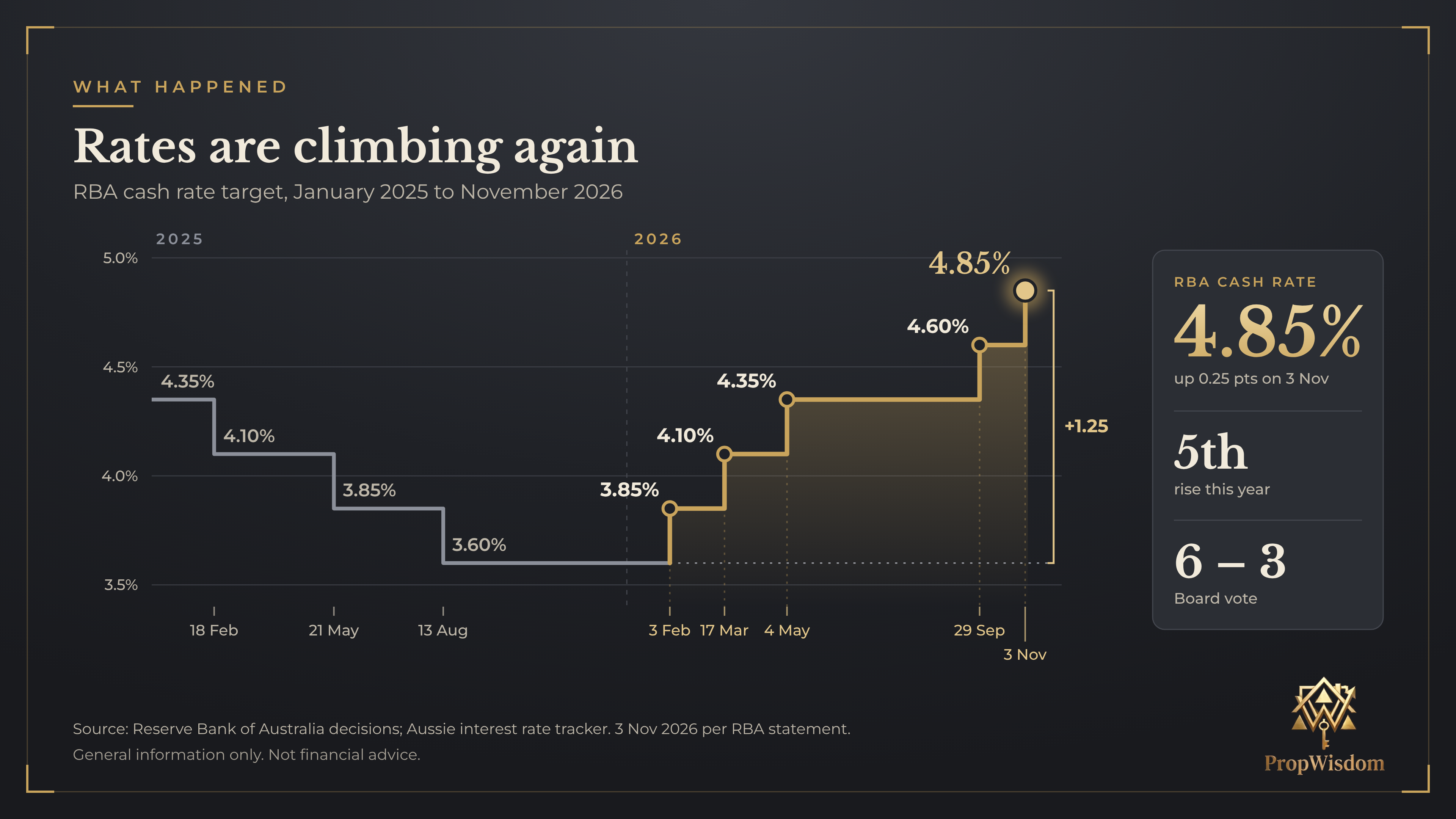
On 3 November 2026, the Reserve Bank of Australia (RBA) raised the cash rate by 0.25 percentage points to 4.85%. It was the fifth increase this year, and the decision wasn't unanimous. Six Board members supported the rise, while three voted against it. For people with mortgages, this isn't just another economic headline. It can mean more money going towards repayments each month, less room in the household budget and some difficult decisions about what comes next. And for anyone thinking about buying an investment property, the uncertainty can be unsettling.
Should you buy now? Wait for rates to come down? Or
forget about investing until the market feels more stable?
These are reasonable questions.
But there's something worth remembering: the best time to buy property isn't necessarily when everyone feels confident. It's when you can find the right property, at a sensible price, and comfortably afford to hold it. That doesn't mean rushing into the market. It means looking beyond the headlines and understanding what's actually happening.
Interest Rates Are Rising. But What About the Rental Market?
When interest rates go up, most of the conversation
focuses on mortgage repayments and falling buyer confidence.
Fair enough. Those things matter.
But if you're considering an investment property, there's
another side of the story you need to understand: what's happening with rents
and tenant demand?
According to SQM Research, Australia's national rental vacancy rate was 1.4% in September 2026. Sydney's vacancy rate was 1.8%. Meanwhile, Cotality reported a national gross rental yield of 3.85% in October 2026, the highest since August 2019.
What does that mean for an investor?
It suggests that rental market conditions deserve just as much attention as interest rate headlines. But here's where buyers need to be careful. A low national vacancy rate doesn't mean every property will be easy to rent. And a higher rental yield doesn't automatically make a property a good investment.
You could have two properties in the same city, both
advertised with attractive rental returns, yet one might be close to transport,
shops and employment opportunities while the other could struggle to attract
reliable tenant demand.
The numbers on the advertisement might look similar. The investment risks could be very different. That's why we believe local research matters so much.
Before getting excited about a property's advertised
rental return, look at comparable rental listings, local demand, the property's
condition and the expenses you'll actually be paying.
The question isn't simply, "How much rent can I
get?"
It's "How much of that rent will I realistically
keep, and can I afford the property if things don't go exactly to plan?"
Could Higher Interest Rates Actually Help Some Property Buyers?
It might sound strange, especially when everyone seems worried about the next rate announcement. But a quieter property market can sometimes work in a buyer's favour.
Think about what happens when confidence is high. A well-presented property comes onto the market. Multiple buyers turn up for inspections. Someone becomes emotionally attached. Another buyer worries they'll miss out. Before long, the conversation is less about what the property is worth and more about what someone is willing to pay to secure it.
Now imagine a different situation. Interest rates have risen. Buyers are more cautious. Fewer people are attending inspections, and a property has been sitting on the market longer than the seller expected. That doesn't guarantee a bargain.
But it may give a financially prepared buyer something
valuable: time.
Time to review comparable sales. Time to organise
inspections. Time to understand the property's condition. And, in some
circumstances, a little more room to negotiate.
Of course, this doesn't happen everywhere. Desirable
properties in tightly held locations can still attract strong competition, even
when interest rates are high.
The point is that market uncertainty doesn't affect
every property in the same way.
Rather than asking whether the entire Australian property
market is good or bad, it can be more useful to ask whether a particular
property represents good value.
Don't Let Tax Benefits Become Your Entire Investment Strategy
Here's something we think property investors should talk about more often. A property can offer tax deductions and still be a disappointing investment.
Tax benefits can be useful, depending on your
circumstances. But a deduction doesn't mean you've made money. It generally
means you may be able to reduce your taxable income after incurring an eligible
expense.
You still have to pay the expense. So before choosing a property because of its potential tax advantages, look closely at the property itself.
Is the purchase price reasonable? Is there genuine rental
demand? How much maintenance might it need? What happens to your cash flow if
interest rates increase again?
And importantly, is there anything you could do to
improve the property over time?
These are the questions that deserve attention.
Sometimes the opportunity is
in what a property could become
Not every good investment opportunity comes in a freshly renovated home with perfect presentation. Sometimes a property needs a little imagination, backed by realistic numbers.
Consider an older house in an established suburb. The kitchen might be dated, the paintwork tired and the flooring overdue for replacement. Those things can put some buyers off.
But if the property is structurally sound, well located and priced appropriately, sensible cosmetic improvements might make it more appealing to tenants or future buyers. That doesn't mean every renovation adds value.
Spending $40,000 on improvements doesn't automatically
increase a property's value by $40,000. The result depends on the property, the
local market, the quality of the work and what buyers or tenants actually want.
We prefer to look at the likely cost of improvements before treating renovation potential as a benefit. It's easy to imagine what a property could look like after renovation. The harder and more important part is working out whether the numbers make sense.
What About Buying a Property With Granny Flat Potential?
This is another area worth exploring, particularly for investors interested in properties with additional accommodation possibilities. A house with a suitable backyard may offer the potential for a granny flat or secondary dwelling. Depending on the location and applicable planning rules, that could create additional living space and potentially another source of rental income.
But there's a big difference between a property that looks suitable for a granny flat and one where a secondary dwelling is actually feasible. You need to consider land dimensions, access, services, drainage, planning restrictions, construction costs and approval requirements. And then there's the rental demand. Would people actually want to rent the additional dwelling? What might they reasonably pay? Would the potential income justify the construction and ongoing costs? These are questions to investigate before buying, not after settlement.
At PropWisdom, we're interested in helping buyers
recognise potential, but we also believe that potential needs to be tested
against practical realities.
A promising idea is only useful if it can be delivered
legally, affordably and in a way that makes sense for the property.
Let's Talk About Rental Yield – Without Getting Lost in the Numbers
Rental yield is one of the first things many investors look at and it's useful. But it only tells part of the story.
Let's say you're considering a property priced at $600,000, with expected rent of $500 per week. That works out to $26,000 a year in rent, giving you a gross rental yield of approximately 4.33%.
On paper, that's a straightforward calculation, but you won't be keeping the full $26,000.
There could be council rates, insurance, property
management fees, repairs, maintenance, periods without a tenant and, of course,
your financing costs.
Now imagine another property offering a slightly higher
gross yield but requiring substantial repairs and ongoing maintenance.
Would the higher yield still make it the better
investment?
Not necessarily.
This is why we encourage buyers to look beyond the
headline figure.
Rental yield matters, but so do property condition,
tenant demand, location, expenses and the price you pay.
A property shouldn't be judged by one percentage alone.
The Biggest Risk Isn't Always the Interest Rate
Higher interest rates are a genuine concern. There's no
point pretending otherwise.
But another risk for buyers is paying too much for a
property because they haven't done enough homework.
Imagine two buyers looking at similar properties.
The first buyer sees an attractive listing, attends one
inspection and makes an offer based largely on the advertised price and rental
estimate.
The second buyer spends time reviewing comparable sales,
checks the property's condition, looks at rental evidence and calculates the
likely holding costs.
Both might end up buying a property.
But the second buyer has a clearer understanding of what
they're purchasing and what could go wrong.
That preparation becomes particularly important when
borrowing costs are high.
A sensible purchase price can give you more flexibility.
Overpaying can make an already expensive investment harder to manage.
And that's why comparable sales matter.
Not the price a seller hopes to achieve. Not the highest
asking price in the suburb. Actual recent sales of properties that are
genuinely comparable.
Good research won't eliminate every risk, but it can help
you avoid decisions based purely on emotion.
So, Should You Buy an Investment Property Now or Wait?
There isn't a single answer that works for everyone.
If higher interest rates would leave you struggling to
meet repayments, waiting may be the sensible choice.
If your income is uncertain, your savings are limited or
you don't have a financial buffer for unexpected costs, there is nothing wrong
with taking more time.
Property investment should not put your financial
security at unnecessary risk.
On the other hand, if your finances are in good shape,
you have a clear investment strategy and you've found a property that makes
sense at the right price, it may be worth investigating.
Waiting for interest rates to fall isn't a guarantee that
buying will become easier.
If borrowing conditions improve, buyer confidence and
competition could also increase. But prices might also weaken in some areas, or
remain subdued for longer than expected.
Nobody can predict those outcomes with certainty.
Rather than trying to guess the perfect moment in the
property cycle, focus on what you can control.
You can control how thoroughly you research a property.
You can decide how much you're prepared to pay.
You can calculate whether you can comfortably hold it.
And you can walk away when the numbers don't make sense.
Those decisions matter in every market.
How We Look at Property Buying at PropWisdom
At PropWisdom Buyers Advocacy, we work on the buyer's
side of the transaction.
Our approach is straightforward. We want buyers to
understand what they're purchasing, why they're purchasing it and whether the
price makes sense.
That means looking beyond attractive photographs and
sales descriptions.
We consider the location, recent comparable sales,
property condition, rental potential and the factors that could affect the
property's suitability.
Where relevant, we also look at opportunities for
cosmetic improvements or additional accommodation, while recognising that
planning, costs and feasibility need to be properly checked.
For interstate buyers, there can be additional
challenges. It's difficult to assess a market confidently when you don't live
nearby or can't attend every inspection yourself.
That's where having research and buying support can make
a difference.
We're a boutique buyers agency, and we value personalised
service. We don't believe buyers should feel pressured to purchase simply
because a property is available.
Sometimes the right decision is to negotiate.
Sometimes it's to investigate further.
And sometimes it's to walk away.
A good buying decision should still make sense after the
excitement of securing the property has worn off.
Our View: Don't Let the Headlines Make the Decision for You
Another interest rate rise is not something to ignore. Higher borrowing costs can put real pressure on households and investors. The RBA's economic outlook, including the possibility of higher unemployment, also deserves serious consideration. But market sentiment and property fundamentals are not the same thing.
A nervous market may create opportunities for some buyers, just as an optimistic market can create risks when competition pushes prices too high. Neither outcome is guaranteed. What matters is understanding your own financial position and assessing the individual property carefully.
Look at the rental income. Understand the expenses. Compare recent sales. Investigate the property's condition and any realistic potential to add value. And be prepared to walk away if the numbers don't stack up.
You don't need to predict the next interest rate decision
to make a thoughtful property decision. You need a clear budget, good research
and the discipline to buy only when it makes sense.
Thinking About Buying an Investment Property in Australia?
If you're considering buying but aren't sure how to
assess the market, we'd be happy to talk through your plans.
Whether you're looking at an established investment property, exploring renovation or granny flat potential, or considering buying interstate, PropWisdom can help you approach the process with more information and confidence.
Contact PropWisdom to Discuss Your Property Buying Strategy
Frequently Asked Questions
Is now a good time to buy an investment property in Australia?
That depends on your financial circumstances and the
property you're considering. Higher interest rates can reduce affordability,
but they may also create negotiation opportunities in certain markets. The
important thing is to assess the purchase price, rental income, expenses and
your ability to hold the property comfortably.
Will Australian property prices fall because interest rates are rising?
Higher interest rates can reduce borrowing capacity and
buyer demand, which may place pressure on prices. However, property markets
don't all move together. Local supply, employment, population growth and demand
can produce different outcomes across suburbs and cities.
Should I wait until the RBA cuts interest rates before buying?
Waiting may make sense if you're concerned about
affordability or need time to strengthen your finances. However, lower rates
could also encourage more buyers into the market. There is no guarantee that
waiting will result in a lower purchase price or a better overall outcome.
Is rental yield more important than capital growth?
Both can matter, depending on your investment objectives.
Rental yield helps you understand income relative to the purchase price, while
capital growth relates to changes in the property's value over time. Neither
should be considered without assessing risks, expenses and the property's
location.
Can adding a granny flat improve an investment property's rental income?
It may, where the property is suitable and the additional
dwelling can legally be built and rented. However, construction costs, planning
approvals, site conditions and rental demand need to be assessed before relying
on potential income.
How can a buyer's agent help in a high-interest-rate market?
A buyer's agent can assist with property research,
comparable sales, due diligence coordination, negotiation and auction strategy.
This may be particularly useful when buyers need to be disciplined about price
and affordability.
Sources: Reserve Bank of Australia –
Monetary Policy Decision, 3 November 2026; SQM Research – Rental Vacancy Rates,
September 2026; Cotality – Australian Rental Market Data, October 2026.
Disclaimer: This article provides general
information only and is not financial, tax, legal or investment advice.
Property investment involves risk, and market conditions can change. Consider
obtaining advice from appropriately qualified professionals based on your
circumstances before making a purchase decision.